


Salt water is drying on your shoulders. Woodsmoke has worked its way into your hair. Somewhere behind you, the lifts have stopped turning, and the first drink is already sweating on the bar. This is the useful hour, the one between activity and socializing, when a man's shirt has to do more than look decent in a photograph.
You're driving home from the beach, heading from the trailhead to the brewery, or stepping off the mountain into a crowded lodge. Your phone can stay holstered. The right shirt keeps your valuables close, your temperature steady, and your hands free for a handshake, a bottle, or an unexpected conversation. These are the moments where men's casual shirt styles earn their keep, not on a motionless mannequin, but in the messy, funny, very human transition into life offline.
The Art of the Analog Transition
At the cabin, the floor is wet with melted snow and somebody has put on music too loud for the room. Outside, the air bites through a T-shirt. Inside, the stove turns the place warm enough to make a heavy jacket feel ridiculous. A well-chosen flannel or overshirt handles that awkward gap without demanding a wardrobe change before the first round of cards.
At the coast, the transition feels different. Your skin is cold from the water, your towel is damp, and the beach bar has the particular glow of a place where nobody knows what time it is. A terry-lined shirt can take the edge off the chill while a clean camp collar keeps the look suitable for tacos, margaritas, and the friend who insists on ordering one more round.
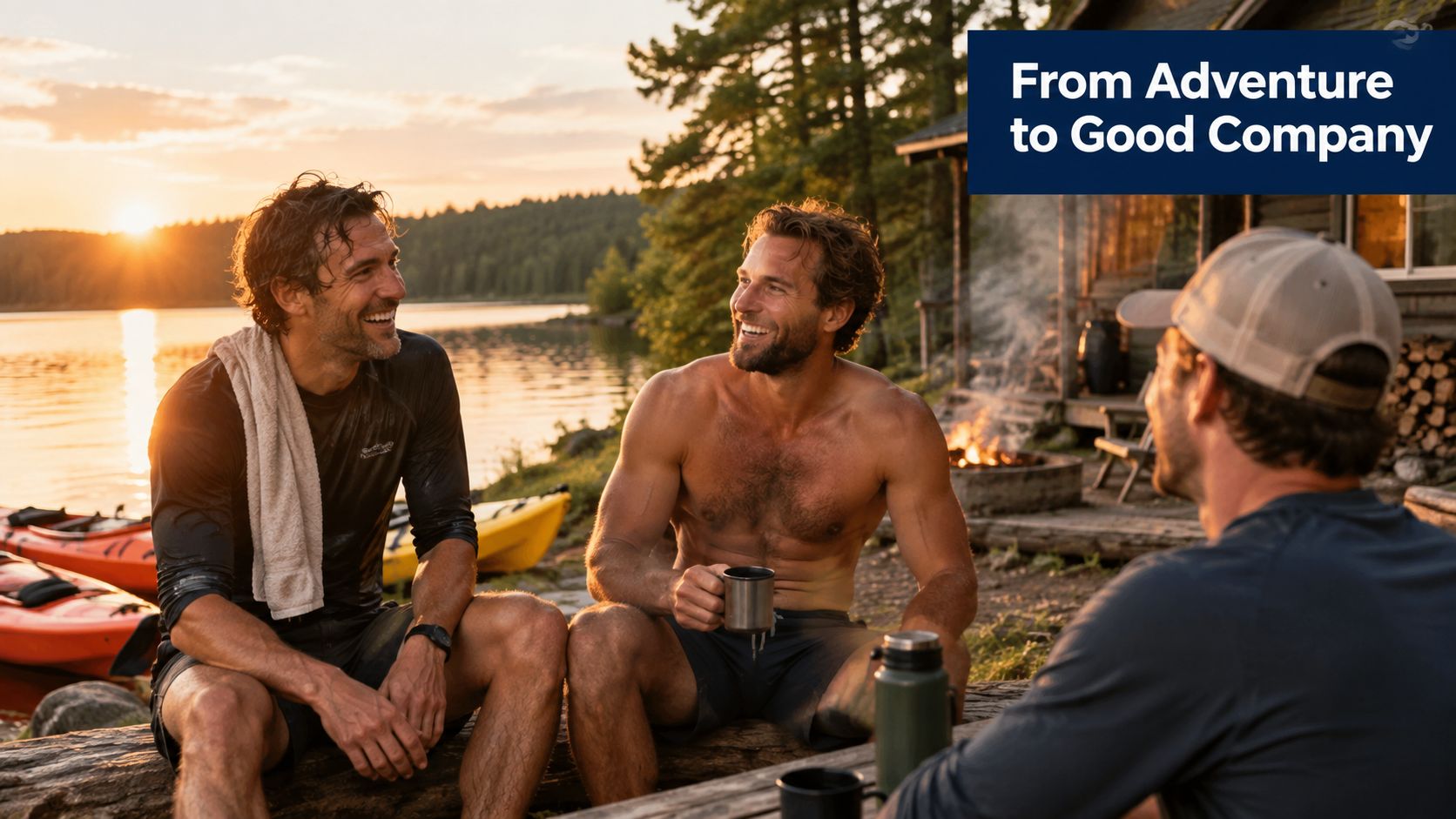
This is the analog transition, the stretch after the sport ends and before the evening settles into its social rhythm. It rewards clothing that can move between places without looking like it came from a costume department. You want enough structure for a restaurant, enough comfort for a cabin couch, and enough personality to start a conversation without shouting across the room.
The offline test: If the shirt helps you put your phone away, carry what matters, and stay comfortable through the next unplanned stop, it's doing its job.
The history of the button-down collar offers a useful clue. In 1896, John E. Brooks reportedly noticed English polo players fastening their collar points so they wouldn't flap during play. Brooks Brothers adapted the detail for everyday clothing and had its button-down “Polo” shirt on sale in New York by 1900, turning a practical sporting feature into a recognizable casual style marker, as this history of the shirt explains.
That origin still matters. The best casual shirts borrow from sport, travel, and outdoor life, then soften the edges for social use. For more on dressing around real-world connection, explore this guide to Life Offline lifestyle gear.
The Anatomy of Social Technical Apparel
A standard casual shirt covers your torso. A Social Technical shirt anticipates what happens after the action starts. You spill something, lose your sunglasses, need your phone away from the damp towel, or discover that the person beside you has brought a bottle but not an opener. Good design makes those small problems disappear before they interrupt the conversation.
The pocket map matters. A dry pocket protects essentials after a swim or paddle. A beer pocket gives a bottle a stable home during a tailgate. A sunglasses loop keeps frames from vanishing into the sand, while a bottle opener loop turns the shirt hem into a tiny piece of event infrastructure. These features aren't decoration. They reduce the amount of gear you need to carry and make hands-free socializing less theoretical.
Fabric has a job after the swim
A shirt's fabric needs to manage heat, liquid, and air at the same time. Cotton feels soft and absorbs perspiration, but its hydrophilic fibers can hold water and dry slowly. Polyester and polypropylene are more hydrophobic, so they generally move liquid faster and retain less moisture, according to research on moisture management in apparel fabrics.
That points toward a useful layered construction. Put an absorbent or hydrophilic layer near the skin, then pair it with a more hydrophobic outer layer that spreads moisture and supports evaporation. Knitted structures with porosity and capillarity can improve vertical wicking, while multilayer designs can outperform comparable 100% cotton fabrics.
Terry cloth works through a different kind of practical magic. Its looped pile creates space to hold moisture, and one technical summary reports that terry constructions can retain moisture equivalent to roughly 5–7 times their dry weight, while fully saturated cotton fibers can absorb up to 24–27 times their own weight. The same source reports that increasing pile height from 2 mm to 4 mm can improve water absorption by approximately 25–35%, with optimized 4 mm piles absorbing a drop in 1–2 seconds, compared with 3–5 seconds for 2 mm piles. Those figures come from this technical overview of terry fabric.
Storage changes the social posture
Hidden storage solves a social problem as much as a practical one. You don't want to clutch a phone through a conversation, wedge sunglasses under a drink, or abandon the group to hunt for an opener. A shirt with purposeful storage lets you stand naturally, move easily, and stay present.
That doesn't mean every pocket should be stuffed. Keep the dry pocket for essentials, use the beverage pocket when the setting calls for it, and leave room for the shirt to drape. For a closer look at the design logic behind hidden pocket shirts, consider the route your day follows rather than the pose you might strike at the trailhead.
Mastering the Mountain and Cabin Shift
The first mistake in après-ski style is dressing only for the chairlift. The second is forgetting that a crowded lodge can feel warmer than the parking lot by a very wide emotional margin. Your shirt needs to bridge the frozen walk from the car, the heat of the bar, and the slow evening back at the cabin.
A luxury flannel, heavy overshirt, or thermal layer works best as a mid-layer, not as a substitute for every other garment. The goal is to trap enough air for warmth while allowing water vapor to escape when you move indoors. Textile testing suggests that fabric selection should account for thermal resistance, water-vapor resistance, air permeability, and thickness, rather than relying on the fiber name alone. Comparative testing found cotton knits with thermal conductivity around 0.042–0.048 W/m·K and thermal resistance of approximately 15–19 × 10⁻³ m²·K/W, while cotton and Tencel-type constructions showed conductivity near 0.031–0.049 W/m·K and moisture regain of roughly 8.5–13%, as reported in comparative textile testing for cool-weather comfort.
Build the layer stack around the lodge
Start with a base layer that sits close without binding. Add a shirt with enough loft to trap air, then use an outer jacket you can remove before you start negotiating for a corner of the bar. A brushed or lined shirt earns its place when it insulates without turning the cabin into a personal sauna.
For a clean High Sierra look, keep the silhouette controlled. A patterned flannel can handle the personality, while a plain tee underneath gives the outfit somewhere to breathe. A western-inspired shirt adds shape through the shoulders and chest, but it shouldn't fight the coat over it. Cabin wear for men works when the layers look intentional, not when every garment appears to have been rescued from a different expedition.
Practical rule: Choose warmth by construction, not by thickness alone. A dense shirt can feel clumsy indoors, while a lofted layer with controlled breathability can stay useful from the first chair to the last pour.
Pack for the hours after skiing
Bring one shirt for movement and one for the social setting if the trip runs long. A slim flannel can work over a T-shirt and under a shell, while a heavier overshirt can take over once you reach the cabin. The right choice depends on how much time you'll spend outside, how warm the indoor spaces run, and whether the shirt needs to tolerate a little spilled cider without becoming a full laundry event.
France offers a revealing benchmark for mountain content. Fewer than 8% of the population takes a winter-sports holiday, yet the most frequent participants, 2–3% of skiers, account for approximately 70–80% of overall participation, according to research on winter-sports participation in France. That concentration suggests a practical audience for High Sierra gear: committed mountain travelers who care about the hours after skiing as much as the descent itself.
For a lined option suited to the mountain-to-lodge handoff, browse lined flannel shirts for men. Choose a fit that leaves room for the layer underneath, but keeps the hem and sleeve openings neat once the jacket comes off.
Navigating the Coastal and Surf-to-Sand Transition
The coastal version of the problem begins with a wet back and ends with a table reservation. A shirt that feels perfect on the beach can look too makeshift at dinner, while a crisp button-down can feel like punishment when salt is still drying behind your knees. Beach-to-bar outfits need a better decision system than “throw on something lightweight.”
Start with the moisture question. Cotton absorbs well and feels familiar, but it can stay wet. A hydrophobic synthetic outer layer may move liquid more quickly, but it can feel less soft against the skin. The most useful architecture pairs a comfortable absorbent inner surface with an outer shell that spreads and evaporates moisture, while preserving enough air exchange for humid conditions.
Compare the coastal shirt families
A terry-lined shirt is the post-surf specialist. The looped lining can absorb water after a swim and provide warmth when the wind picks up, but it may feel heavier if it becomes saturated. Research on cotton terry fabrics identifies fiber material, yarn type, yarn count, twist level, pile height, and pile shape as variables that influence absorbency. Static water absorption and drying rate both matter, because a shirt that takes up moisture quickly isn't automatically a shirt that dries quickly. Those distinctions are outlined in research on terry fabric performance.
A camp-collar shirt is the social chameleon. Its open collar and relaxed shape suit the beach, a patio, and a casual restaurant, especially when the print carries the visual interest and the rest of the outfit stays simple. The style belongs to a longer history of expressive sport shirts. The U.S. National Park Service notes that sportswear gained broad popularity in the 1930s through knit polos, T-shirts, and short-sleeved sport shirts, while early Hawaiian shirts used fabrics such as kimono silks in Hawaii during the early 1930s. “Aloha Shirt” was trademarked in 1937, and tropical sport shirts had spread across the United States by 1950, as documented in the National Park Service history of the casual sport shirt.
A lightweight button-down sits between the two. It handles travel, casual work settings, and dinner without announcing that you came directly from the water. It won't offer terry's towel-like absorption, but it can pack more easily and dry with less bulk.
Read the first minutes, not just the final dryness
Textile wicking depends on capillary forces, which move liquid through fabric pores. In one study, researchers separated moisture transfer into an initial 10-minute wicking and evaporation phase and a later 110-minute phase. The early period dominated the overall process, which supports a useful coastal insight: fast initial spreading can improve comfort immediately after exertion, but total drying still depends on thickness, density, construction, and fiber choice, as described in research on fabric wicking and evaporation.
For a practical surf-to-sand layer, see coastal comfort clothing. Pick the terry option when warmth and post-water comfort lead the day. Choose a camp collar when social versatility matters more. Reach for a breathable button-down when the schedule includes travel, dinner, and a suspiciously optimistic attempt to look organized.
Coordinating Group Outfitting and Event Dynamics
A bachelor party outfit shouldn't make six grown men look like they've been assigned to direct airport traffic. The strongest group dressing creates a shared visual cue, then leaves enough room for individual posture, tattoos, footwear, and questionable dance decisions.
Matching luxury flannels can work for a cabin weekend because the setting already provides a common language. For a wedding, custom monogrammed robes can mark the morning without forcing the entire day into identical clothing. At a music festival, coordinated color or fabric may be enough. One man wears the shirt open over a tee, another buttons it cleanly, and a third has somehow paired it with a hat that belonged to his uncle.

Coordinate the anchor, not every detail
Choose one shared element, such as a color family, fabric weight, monogram, or pocket detail. Let the rest respond to the event. A beach ceremony may call for linen-like texture and open collars, while a mountain bachelor weekend needs warmth and room for layering. A festival crew benefits from storage, breathable construction, and a hem that can survive sitting on questionable grass.
The group also needs to move. Hidden pockets help people keep phones, cards, and small essentials close without carrying a full daypack into every conversation. Utility loops can hold sunglasses or support the small rituals that make a gathering feel relaxed rather than managed.
Wine-country events offer another useful model. Groups planning a tasting day, rehearsal gathering, or shared celebration can explore wine club group experiences for ideas about pacing, setting, and the way clothing has to serve both movement and conversation.
The visual goal is coordinated but cool. Give the group a common starting point, then allow different fits and styling choices to do the rest. That approach makes the clothing part of the memory instead of turning it into evidence that everyone received the same spreadsheet.
Here's a little visual reference for the social side of coordinated gear:
For group orders, start with the activity, not the garment. Decide whether the weekend involves water, cold, long walks, formal photos, or all of the above. Then choose a shirt that gives everyone the same social permission to relax while preserving enough personal choice to avoid the tour-group effect.
The Fit Diagnostic for Real-World Movement
The word “relaxed” has caused more shirt-related confusion than a wet phone in a beach bag. A casual shirt doesn't need to be universally oversized. It needs the right amount of room in the places that move, with enough control at the hem and sleeves to keep the outfit from collapsing.
Consumer-signal data identifies inaccurate sizing in 48.1% of negative comments about men's casual shirts, while inconsistent quality appeared in 20.7%, according to consumer discussion analysis of men's casual shirt trends. Those figures point to a straightforward problem. Shoppers don't only need style names. They need checkpoints they can use before the shirt arrives and after they put it on.
Start at the shoulders
The shoulder seam should sit close to the shoulder's natural edge for a well-fitting casual shirt. A relaxed overshirt can extend slightly farther, especially when it needs to sit over a tee or thermal layer, but the seam shouldn't fall so far down the arm that lateral movement feels restricted.
Raise both arms. Reach across your body. Sit down. If the shirt pulls sharply across your upper back, the problem isn't solved by calling it “athletic fit.” If the shoulder feels right but the chest binds, look for more torso ease rather than automatically sizing up everywhere.
Match ease to the layer underneath
A shirt worn over a T-shirt needs room through the chest and upper back, but it should still close without strain. A heavy overshirt worn over a hoodie needs more space, particularly around the armhole and sleeve. That extra room should serve movement, not create a dramatic curtain around the body.
A camp shirt intended for a restaurant can sit closer through the torso. Keep enough ease to breathe and reach across a table, then look for a cleaner drape at the hem. Broad-waisted men often benefit from room through the middle with a straighter, controlled hem. Taller men should check that the shirt doesn't finish too high when they raise their arms. Shorter men may prefer a shorter hem and less excess fabric so the relaxed silhouette doesn't swallow the frame.
Fit check: If the shirt looks good standing still but rides up, strains, or catches when you drive, lift a glass, or reach for a deck chair, it isn't fitted for your actual life.
Sleeve openings deserve attention too. A wide opening can improve airflow in warm weather, but it may look untidy under a jacket. A closer cuff works for layering, provided it doesn't trap heat or stop the elbow from bending comfortably.
For a reliable starting point, use this guide on how to measure for a shirt. Measure the garment against the layer you plan to wear underneath, not against an imaginary version of yourself who owns no hoodie, carries no towel, and never orders fries.
Complete the Look and Care Tactics
The outfit builder is simple. Start with the shirt's main environment, then add accessories that support the transition rather than compete with it.
- Mountain layer: Pair a flannel or overshirt with a plain tee, durable pants, and a hat that can handle cabin smoke without requiring a formal apology.
- Coastal layer: Use a terry-lined shirt or camp collar over swimwear or a lightweight tee. Add a koozie for the cold drink and a cap for the walk from sand to patio.
- Event layer: Keep the base shirt coordinated, then let each person choose footwear, hat shape, or tee color. Matching doesn't require surrender.
- Hands-free layer: Use the dry pocket for essentials and the sunglasses loop for frames. Leave decorative clutter at home. A pocket isn't a junk drawer with stitching.
Care preserves the features that made the shirt useful. Follow the garment label, wash technical layers with similar fabrics, and avoid treating terry lining like a disposable towel. Excessive heat can affect fit and fabric feel, while overloading the machine can prevent a thick lining from rinsing properly. Dry the shirt thoroughly before storing it, especially after saltwater use, and hang structured shirts so the collar and shoulders recover their shape.
A flannel that traps air needs to keep its loft. A terry lining needs to dry fully. A camp collar needs gentle handling so its relaxed shape stays relaxed rather than becoming an accidental flag. Store each shirt clean, dry, and ready for the next drive home, lodge pour, cabin breakfast, or sunset fire.
For more men's casual shirt styles engineered around social living, use the California Cowboy collection to build a mountain, coastal, or group outfit that keeps your hands free and your plans pleasantly loose. Then join the Vital Few newsletter for first access to product drops and more reasons to holster your tech, meet someone interesting, and stay out a little longer.

